


The Boy Who Shared His Lunch: Understanding John 6:1-15
"If we want to be used by God, we must put ourselves in the position where God can use us."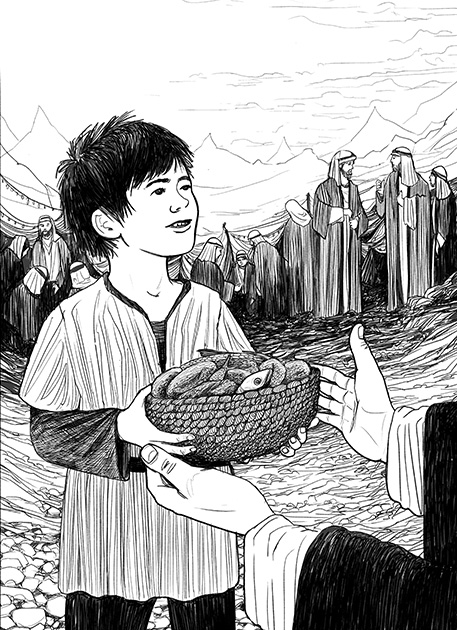
This story of a boy who shared his lunch is the only miracle besides the resurrection that is recorded in all four Gospels. When the Bible says something once, it is important. When the Bible says something twice, it is very important. When the Bible repeats the same story four times, it is very, very, very, very important. It is like when I was a child and my mother would say, “I told you!” When I heard those words, I knew that I was in a lot of trouble because I had been warned, and yet I had disregarded that warning. When I heard, “I have told you time and time again!” I knew that I was in really hot water, because I had not merely ignored my mother’s warning once but had done so “time and time again.”
In their telling, Matthew, Mark, Luke, and John all record that there were just two fish and five loaves of bread, but none of them bothered to record the name of the boy who provided the food. In fact, to know much about this boy, we have to look closely at the passage. John 6:9 (NIV) tells us, “Here is a boy with five small barley loaves and two small fish, but how far will they go among so many?”
The first thing we notice is that the boy had come prepared. John’s telling of this story begins with:“Some time after this, Jesus crossed to the far shore of the Sea of Galilee (that is, the Sea of Tiberias), and a great crowd of people followed him because they saw the signs he had performed by healing the sick” (John 6:1-2 NIV).
John seems to imply that the crowds were following Jesus expecting him to do some sort of miracle, because He had been healing the sick. Matthew and Mark indicate in their telling of the story that this was a “solitary” place (Mark 6:32, Matthew 14:13). It seems that many in the crowd following Jesus were hoping to catch a glimpse of the miraculous without thinking about where they were going and what would happen when they got there.
How often have we been guilty of wanting to see God’s power without being prepared for God’s work? There is an old story about a church that decided to come together to pray for rain during a drought. The pastor called all the people to meet in a field where the plants were slowly dying from lack of moisture. Of the people who showed up that day, only one believed enough to bring an umbrella. In the same way, we pray to God for manifestations of his power, that we are not prepared to receive. If we pray for God to double our church attendance, we ought to be thinking about where all those people are going to sit. Maybe we will have to give up our own seat. If we pray for God to heal our bodies, we ought to be preparing for what we will do for the Kingdom when we are healed and whole. If we want to see God’s transforming power, what are we doing to prepare our hearts and lives for that power? It is sobering to think of all the blessings that we have missed because we were not prepared to receive them. If we pray for rain, we need at least enough faith to bring an umbrella.
Returning to verse 9, notice how the verse begins: “here” or “there” depending on your English translation. The boy showed up! We read no mention of his parents being in attendance or that he was there with a group of friends or relatives. For all we know the boy could have chosen to be anywhere on this day with his lunch, but he chose to be “there” in the presence of Jesus. If we want to be used by God, we must put ourselves in the position where God can use us. Surely God could have used anyone to slay Goliath, but only “David said to Saul, ‘Let no one lose heart on account of this Philistine; your servant will go and fight him’”(1 Samuel 17:32 NIV). God could have empowered anyone to rebuild the walls of Jerusalem and restore its people, but only Nehemiah prayed to God and said, “If it pleases the king and if your servant has found favor in his sight, let him send me to the city in Judah where my ancestors are buried so that I can rebuild it” (Nehemiah 2:5). In Esther 4:14 (NIV) Mordecai reminds his niece, Esther, “For if you remain silent at this time, relief and deliverance for the Jews will arise from another place, but you and your father’s family will perish. And who knows but that you have come to your royal position for such a time as this?” In other words, God could have miraculously saved the Jews from Haman’s wrath using anyone or no one, but instead God placed Queen Esther in the palace for “such a time as this.”
The overwhelming evidence of scripture and church history is that God does not always use the most qualified (the biggest, the strongest, the smartest, the best-looking). God does not always use the person with the most accolades or achievements. God does not always use the most talented or the best in their field. Frankly God does not need to use them. According to 1 Corinthians 1:28-29 (NIV) “God chose the lowly things of this world and the despised things — and the things that are not — to nullify the things that are, so that no one may boast before him.” God uses the available and makes them through his power into his chosen instrument. When a lunch was needed, the boy was present and made it available for Jesus to use and multiply.
This boy held nothing back. While we might imagine two fish and five loaves of bread as a feast, it was a modest lunch designed to feed a single boy. While the rich preferred bread made of finely milled wheat, barley was the grain of the poor. The five loaves of bread were likely no more than the size of the palm of a hand. Similarly, the fish were small salted or pickled fish which were probably only 10-15 centimeters in length. Remember that this boy had followed Jesus like the rest of the crowd to a remote place. We can imagine that the boy was tired and hungry by the time that Andrew discovers he had some food. It must have been tempting for the boy to hold back a fish and a couple of loaves of bread for himself. Perhaps the boy thought that he had been especially chosen to share his lunch with Jesus alone and not the multitudes. Whatever the circumstances, when given the opportunity to give his lunch to Jesus, there is no evidence that the boy hesitated or held back. He gave what he had to Jesus.
Most often the problem with our giving is not our willingness to give or even the amount we give. The problem is our lack of faith. When we give, we do so hesitantly and half-heartedly. Let me explain what I mean. In the USA when it comes time for Valentine’s Day, the school children are assigned to bring valentines for all their classmates. When the children were little, this was a lot of fun. They excitedly chose valentines with their favorite characters — superheroes that declared “Valentine U R Super,” or cats with a caption that read “Valentine U R Purrfect.” A few years later, as our children got a little older, a change happened. I can remember our son declaring one year that he refused to bring valentines that were pink, had “love” on them, or were “too girly.” Of course, this severely limited our choices. Suddenly Valentine’s Day became a struggle. Give away a nice card to the wrong person and they might believe that you “liked them” which as you can imagine was an existential crisis for a 10-year-old boy. Sure, there were still school Valentine’s Day parties and until the assignments mercifully ended in middle school my kids still dutifully brought valentines for all their classmates, but the joy and fun of those early years had been replaced by dread and careful calculation.
When we give do we experience excitement, joy, and freedom? When was the last time we boldly made an offering to God without carefully considering how God might use it? The Apostle Paul wrote this to the Corinthian believers:
Remember this: Whoever sows sparingly will also reap sparingly, and whoever sows generously will also reap generously. Each of you should give what you have decided in your heart to give, not reluctantly or under compulsion, for God loves a cheerful giver (2 Corinthians 9: 6-7 NIV).
When a boy gave his humble lunch to the Lord, the result was a miracle. When we give our all to the Lord, he will multiply and use it in ways we can’t imagine.
Feeding the 5,000: John 6:1-13
6 After this, Jesus crossed over to the far side of the Sea of Galilee, also known as the Sea of Tiberias. 2 A huge crowd kept following him wherever he went, because they saw his miraculous signs as he healed the sick. 3 Then Jesus climbed a hill and sat down with his disciples around him. 4 (It was nearly time for the Jewish Passover celebration.) 5 Jesus soon saw a huge crowd of people coming to look for him. Turning to Philip, he asked, “Where can we buy bread to feed all these people?” 6 He was testing Philip, for he already knew what he was going to do.
7 Philip replied, “Even if we worked for months, we wouldn’t have enough money to feed them!”
8 Then Andrew, Simon Peter’s brother, spoke up. 9 “There’s a young boy here with five barley loaves and two fish. But what good is that with this huge crowd?”
10 “Tell everyone to sit down,” Jesus said. So they all sat down on the grassy slopes. (The men alone numbered about 5,000.) 11 Then Jesus took the loaves, gave thanks to God, and distributed them to the people. Afterward he did the same with the fish. And they all ate as much as they wanted. 12 After everyone was full, Jesus told his disciples, “Now gather the leftovers, so that nothing is wasted.” 13 So they picked up the pieces and filled twelve baskets with scraps left by the people who had eaten from the five barley loaves.
Illustration by Rohan Eason | This article was originally titled “Nameless & Known: A Boy Who Shared His Lunch (John 6: 1-15)” in the June 2026 issue of The War Cry.