


Party in the USA: How to Celebrate America’s 250th Birthday
“... and the heralds go before them, saying ‘Make way for the image of God!’”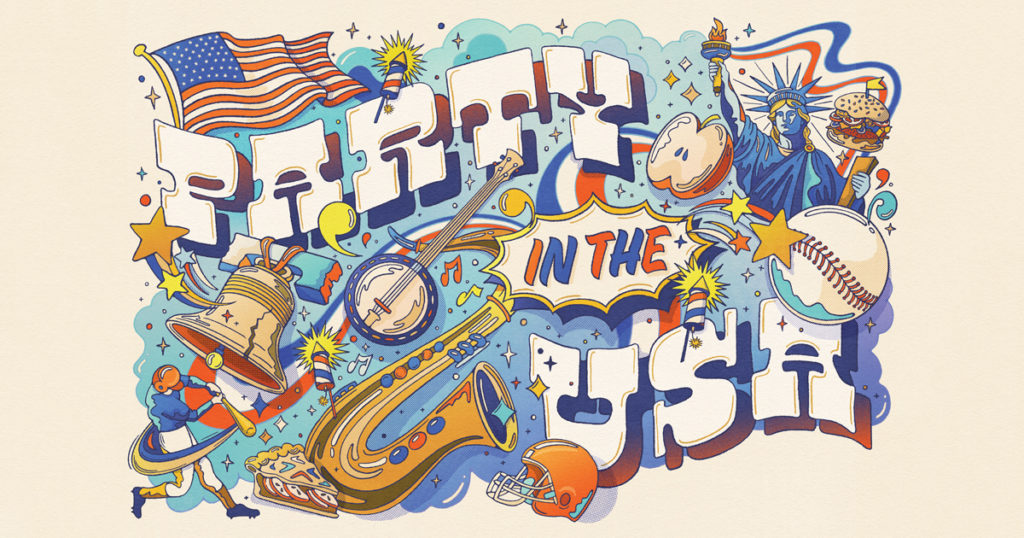
Relatively early in life, around the age of 12 or 13, I became consumed by (or afflicted with, depending on your perspective) an insatiable interest in politics. I’m not sure entirely why. Cable news certainly played a part, but C-SPAN even suited my fancy. Nothing seemed to rivet me more than a three-hour-long congressional hearing of the House Ways and Means Committee. How thrilling, right? My questionable athletic prowess and musical abilities certainly contributed, too. I played baseball as if I saw, in the words of the Apostle, through a glass darkly. As the curtain rose on my 7th grade band concert, I looked down at my stand to see my sheet music missing. I sheepishly informed my bandmaster. He furiously signaled, first, for the curtain to be lowered and second, for me to go grab my folder from my locker. Unfortunately, having my music did little to improve my performance.
Another culprit for my political interest was my 8th grade history teacher, Ms. Maple. At some point, asking her about history before school became asking her about current events. She didn’t shoo me away. She kindly engaged my questions, never telling me what to think but encouraging me to think. We made a habit of it. Whether wondering what China’s purchase of Treasury bonds might mean for US economic security or comparing scorecards from the most recent Presidential debate, Ms. Maple and I had about 15 minutes each morning to dissect the news. We typically didn’t see eye-to-eye. Yet, despite our differing views, or perhaps because of them, I always enjoyed our conversations.
I recall one such morning, we discussed a story generating a lot of heat and shedding little light in that news cycle. Our discussion of the matter, I’m happy to say, was much more civil than what could be seen on cable the night before. We didn’t agree on the issue, but we disagreed respectfully, nonetheless. However, as I returned to my desk, a friend asked me what Ms. Maple had to say about the topic, and suddenly my tone shifted. Sensing an opportunity for a cheap joke at Ms. Maple’s expense, I said in a snarky voice, “She just wants them to die.” Gone was all of Ms. Maple’s carefully worked-out nuance and concern for the human beings involved. I had reduced her thoughtful viewpoint to a soundbite meant to demean her behind her back.
I didn’t know that Ms. Maple could still hear me from across the classroom. Then she confronted me. I was mortified and apologized. She was characteristically gracious and forgave me. In so doing, she reminded me that we all share something more profound and vital than our disagreements, political or otherwise.
I’m mindful, in this 250th year since the Declaration of Independence, of the things we Americans all share. America has historically had a genius for uniting and working together in shared projects. Our national motto, E Pluribus Unum, “out of many one”, enshrines and celebrates this aspect of our national character.
Alexis de Tocqueville, the 19th-century French diplomat and intellectual, in his seminal work “Democracy in America,”marveled at the capacity of Americans to form societies and associations of all sorts: “religious, moral, grave, futile, very general and very particular, immense and very small.” He observed that Americans used associations “to give fêtes [parties], to found seminaries, to build inns, to raise churches, to distribute books, to send missionaries to the antipodes” and to “create hospitals, prisons, schools.” Tocqueville concluded there was “scarcely an undertaking so small that Americans do not unite for it … Thus, the most democratic country on earth is found to be, above all, the one where men in our day have most perfected the art of pursuing the object of their common desires …”
I don’t mean to be pollyannish about how united Americans were in the 1830s. After all, 25 years after “Democracy in America”’s publication, America fought a civil war. Nevertheless, Alexis de Tocqueville did capture something true about the US. From the beginning to the present, one of its greatest strengths has been the ability of its people to organize for the collective good, not merely for political purposes but in an endless variety of civil and ecclesial groups.
At root, America’s preoccupation with banding together in common cause stems from the recognition that all people “are created equal, that they are endowed by their Creator with certain unalienable Rights, that among these are Life, Liberty and the pursuit of Happiness.” Our ideals of equality and rights, developed in the enlightenment, build upon the older Judeo-Christian idea that all people are created in the image of God. I didn’t think about the image of God in that classroom as I regretted my coarse words. But I did recognize it implicitly when acknowledging I had done something wrong. I had demeaned something my teacher and I both shared: God’s image.
We’ve begun as a society to think we can achieve through politics the conditions that make our politics function, putting the politics-cart before the social-cohesion-horse. As Tocqueville discerns, “In democratic countries the science of association is the mother science; the progress of all the others depends on the progress of that one.” Our ability to ensure a brighter future for our children and their children depends upon our ability to associate amid our diverse viewpoints, recognizing that God’s image unites us. God’s image clothes us with immeasurable dignity and value. God’s image imparts in us our faculties for ruling, reasoning and relating. God’s image, when restored fully by His grace, enables us to imitate Christ and to love one another.
I struggle with the implications of the image of God. As I scroll on my social media feeds, I sometimes find myself frustrated by what I see. Perhaps you do, too. I still follow the news closely today. I stay informed, vote in each election, and look for ways to participate in the political process. I often hear Karl Barth’s famous admonishment in my mind to “hold the Bible in one hand and the newspaper in the other.” Yet, the tenor of our political discourse and the consequent fraying of friendships and families trouble me — especially when one remembers that on both sides of every heated debate are God’s image-bearers. Much of our lives occurs in frictionless digital spaces — social media pages where we can enter and exit a person’s life with the click of a button, making severe judgments we say or don’t say. What does it mean to have the integrity to relate to all people in full view of the reality that everyone bears the divine image?
I recall the rabbi who commented: “A procession of angels passes before each person, and the heralds go before them, saying, ‘Make way for the image of God!’” Do our attitudes and actions reflect this sort of reverence for the image of God in all people — even those we see as political adversaries?
It may or may not shock you to hear that broken and even sinful people are at your church. Worse still, someone with whom you disagree fervently about politics, faith or (and I shudder at the thought) sports could also be there. Hear the good news, they’re all God’s image-bearers, too. Don’t stop caring about the issues. Don’t stop having honest debates or participating in the political process. But do stick around.
We go to church in remembrance of the One who gathered at His table twelve of His betrayers and offered Himself without reservation.
The image of God demands much of us in Christian theology, more than we can give. At church, we discover that love for all image-bearers, adversaries included, cannot be summoned on our own but must be given to us by grace through faith. When asked to provide the greatest commandment, Jesus says to love the Lord your God and that the second, loving your neighbor, is like it. Loving neighbors is like loving God because to love God is to love also His image-bearers. Our inability to love like this illustrates our need for God to impart in us His selfless love. The extent to which we tangibly love others demonstrates just how filled with His love we’ve become.
So how should we celebrate America’s 250th birthday? First, have your fair share of Americana, from fireworks to baseball to apple pie, bluegrass to the blues. American culture, in all its diversity, at its best reflects God’s delight in human creativity and joy-filled community. Second, approach someone across the political spectrum from you for an in-person dialogue on a difficult and thorny issue. Do so, not to try to persuade them of your position but to better understand theirs. Third, love your church. Spend time there on Sundays and during the week. Come for Bible study and youth night. Donate to the food pantry. Participate in small groups. Ask your leaders how you can get involved. Nothing could be more crucial to the renewal of American democracy than the renewal of that greatest of civil associations: the Church. No matter our talents (or lack thereof), interests or perspectives, we all bear the image of our Maker who comes to make our love more perfect. May perfect love, God’s holy love in us, be the basis of a more perfect union in the next 250 years to come.
Illustration by Lively Scout