

September Morn
A collection of first-hand reflections from those who served at Ground Zero, the Pentagon, and Flight 93 sites on 9/11, recounting their memories of that day and its lasting impact 25 years later.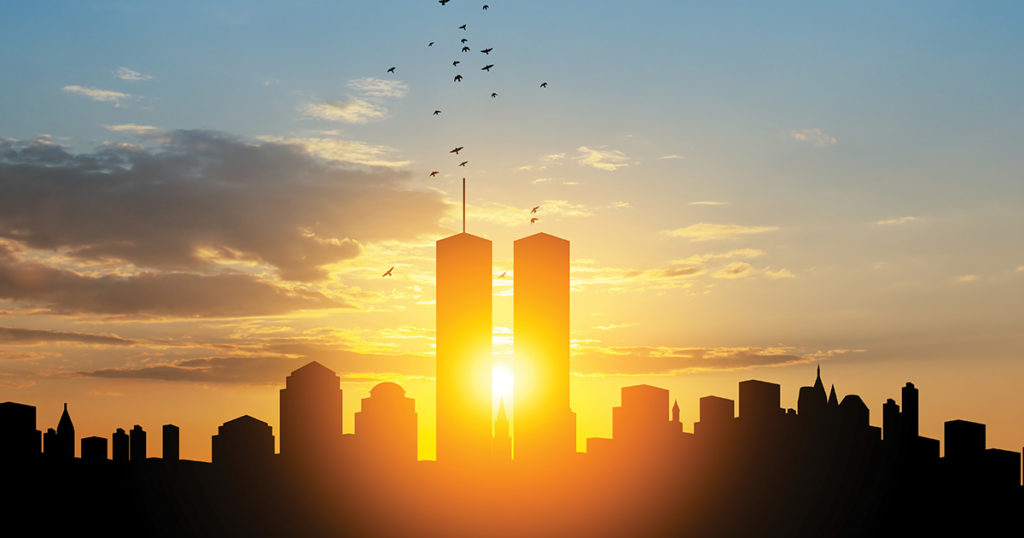
Twenty-five years have passed since that September morning in 2001 that changed the world. Just as anyone alive during the attack on Pearl Harbor in 1941 or the assassination of President John F. Kennedy in 1963, all Americans alive that day can recall where they were when they heard the news of what we now commonly call 9/11. What was before only a number dialed in case of an emergency became emblematic of a national emergency and the horror perpetrated by men bent on taking life and destroying our very way of life. But the infamy of their acts did not have the last word. Braver men and women raced toward the fires to rescue victims and worked in the aftermath to recover and rebuild. America united behind them, resolved to ensure such a catastrophe never happened again.
In today’s more divided era, one mantra continues to bring our political factions together: Never Forget. More than a focus on the singular historical significance of 9/11, the pledge to never forget that day calls us to remember not only the terror and loss, but also the heroism of victims, firefighters, police officers, and other first responders who answered the call to serve without reservation.
Salvation Army officers, staff and volunteers began 9/11 much like most Americans: at home, in the office, dropping off kids at school, meeting in community groups, and so on. Lt. Colonel Raphael Jackson visited the IT department at the Greater New York Division’s headquarters in Manhattan. He stood there staring out the window upon a scene familiar to all New Yorkers: The World Trade Center buildings rising high above the world’s financial capital. He left for the board room and found the phones “ringing off the hooks.” He heard the news. He ran back to the IT department. He looked out their window and saw a scene entirely unfamiliar: The World Trade Center buildings mortally wounded and teetering, on the verge of collapse. Approximately 30 minutes later, American Airlines Flight 77 crashed into the Pentagon in Arlington, VA. When the first tower was struck, many wondered if a terrible accident had occurred. By the time of Flight 93’s crash outside Stony Creek Township, PA, it was clear that the nation was under attack, and The Salvation Army would be called to serve. What follows are accounts of that remarkable service — service we have pledged to never forget.
Where and in what capacity did you serve?
Major Molly Shotzberger: I was the emotional and spiritual care officer at Ground Zero, the morgue, and Fresh Kills. Most of my time was at Ground Zero. I was there from September to May — nine months. I may have been the only one to serve at all three places.
Major Evelyn Chavez: I served in our tent at the edge of the pit. Ours was the tent across from the church that remained standing. Attached to our tent was the morgue tent. I served as the on-duty chaplain. My shift was from 11 p.m. to 7 a.m. Mostly, I gave a listening ear, prayer, and refreshments to the many workers trying to unbury the truth of what had happened in this catastrophe.
Major Melody Coulson: Major Vivian Childs and I served at the Pentagon. We conducted counseling sessions, held babies, gave teddy bears, and cried and held those who lost their loved ones.
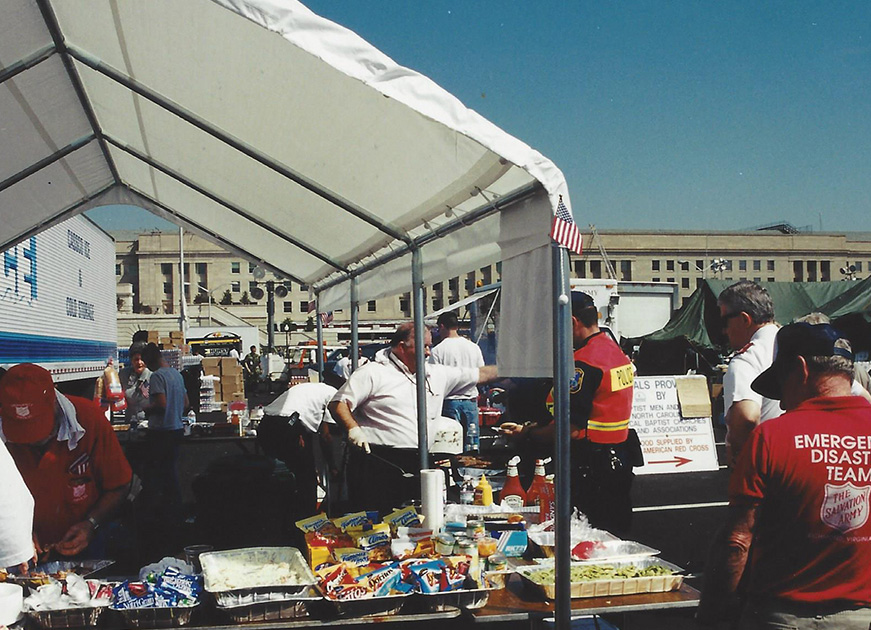
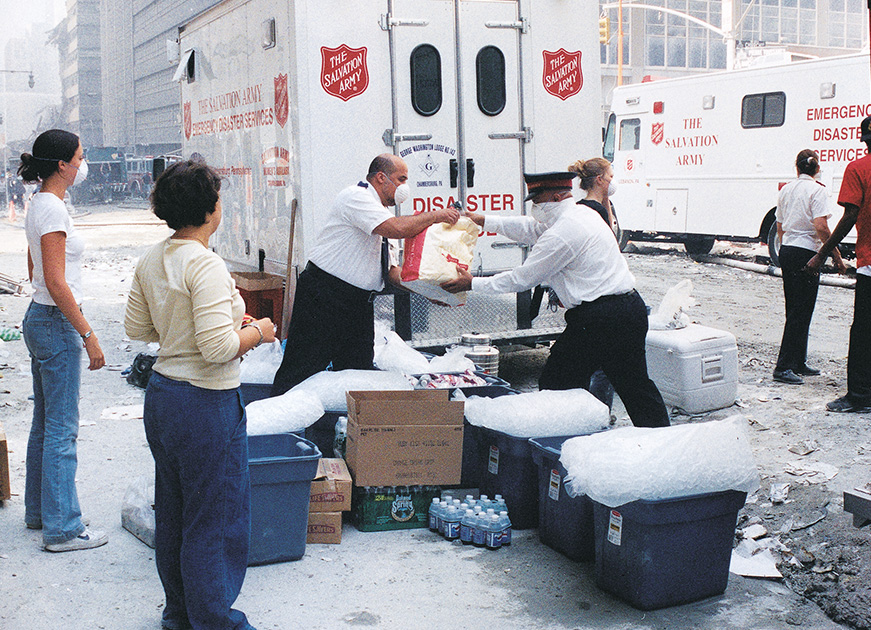
Major Carl Schoch: Here in the Greater New York Division, we immediately had our Emergency Disaster Services Command Center activated to oversee personnel and vehicles. The Army was the first response agency on site in the Zone within an hour and remained on site until the Honor Guard removed beams and flags from The Pit nine months later. The first canteen was joined by 18 others strategically placed throughout the Zone. In addition, three tractor trailers towing commercial kitchens joined the response and fed around the clock. Major Stephen Banfield (general secretary) shared Incident Command responsibilities with me. Major Steve Langford (divisional secretary) and Major Michael Sharp served as our “go to guys.” Support from all sources, including “walk-ons” would number close to five thousand responders.
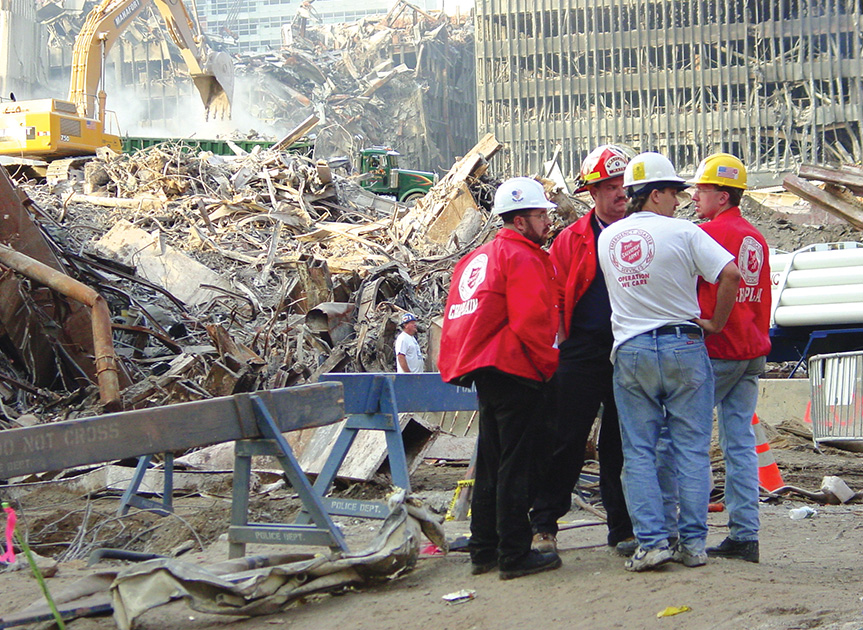
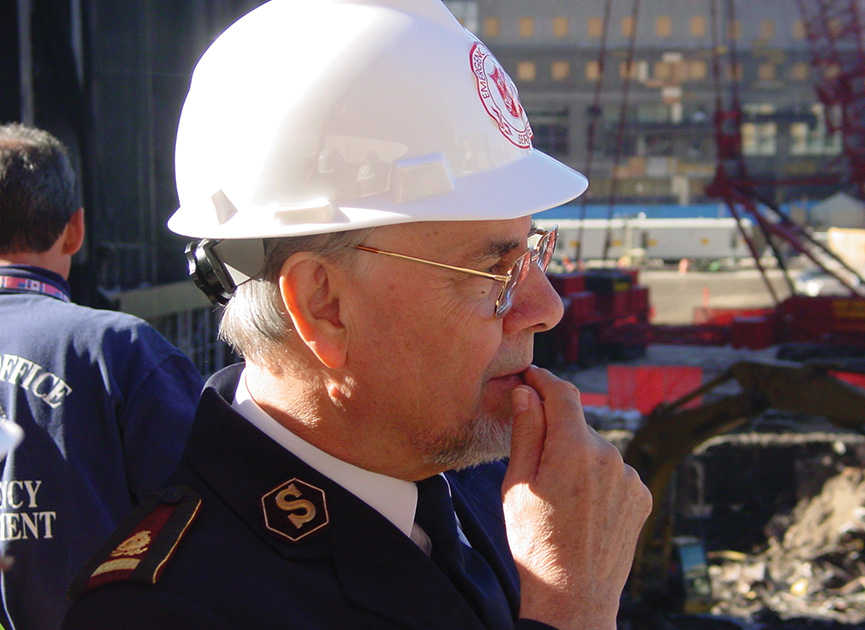
Commissioner Ralph Bukiewicz: I was honored to serve as public information officer for six weeks in the Fall of 2001. I had many unique and powerful experiences as I served in the EDS leadership team and was active in all efforts at Ground Zero and the Red Zone. General John Gowans joined us in touring the site from the vantage point of the rooftop of the 51-story American Express Tower directly between the North Tower and the Hudson River.
Warren L. Maye: In SAConnects we reported that The Salvation Army’s involvement was dubbed “Compassion Under Fire,” reflecting our commitment to long-term support. We were the first relief agency at Ground Zero, arriving within 30 minutes of the first plane crash. The Army was granted control of the feeding operation at a site known as the “Taj Mahal,” a large tent that became a haven for tired rescue workers. Supported by the local New York City restaurants through the “Restaurant Relief Program,” The Salvation Army provided food at the Taj and essential items to relief workers. Most significantly, the Army’s pastoral caregivers offered emotional and spiritual support to those working under extreme conditions.
Lt. Colonel Robert Webster: I was first assigned to take applications for individuals who had lost essential services and needed assistance. However, my expertise was as a firefighter chaplain with Critical Incident Stress Management training from the New Albany (Indiana) Fire Department. I was told when I left the Central Territory for NYC that I would be working with firefighters at Ground Zero. On my second day in NYC this became reality.
Bill Feist: As Red Zone coordinator, I was responsible for ensuring that The Salvation Army’s Red Zone operations continued smoothly and had the supplies, equipment, and personnel they needed. The Red Zone was the area immediately surrounding the collapsed World Trade Center towers and was known as The Pit. The Federal EPA had set up an exceptionally large dome and were using half of it — part of which was a decontamination station for people coming out of The Pit. The Salvation Army was using the other half for feeding the first responders and civilian responders (construction folk and others working in The Pit). This was being done in partnership with the Southern Baptists and several restaurants within the security perimeter that were providing the food. There were also three tents where the first responders could come for a quick break, hydration, ESC, and so on.
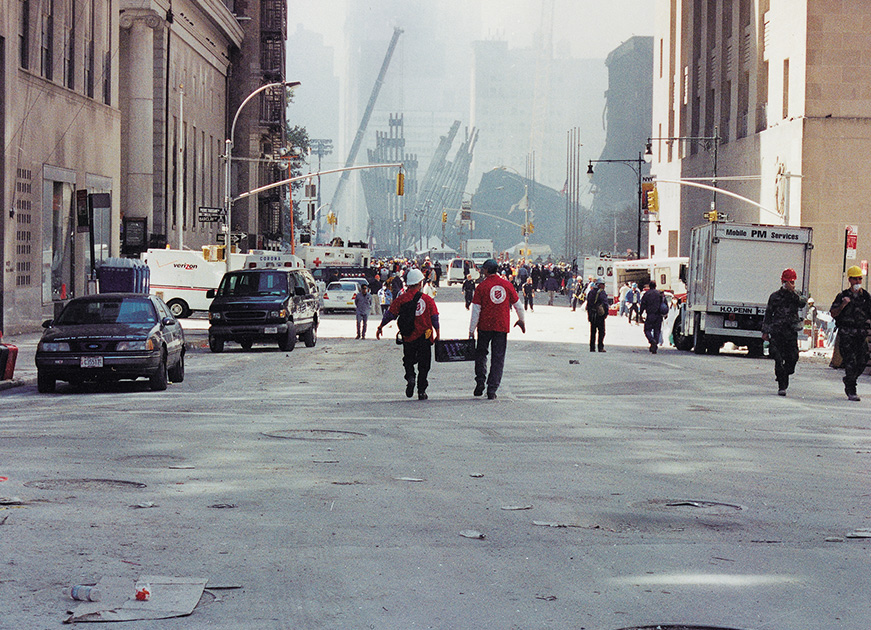
Commissioner James Betts: I was ordered to report to New York City to provide support for those working at Ground Zero. Smoke was still rising from the rubble, and fear was still gripping all who were working at the site. There were still buildings threatening collapse, and logistics were still very loose and lacking. No one involved had ever been through anything like this before, and as a result, much of it had to be figured out in real time.
Major Ron Fenrich: I was deployed by the Southern California Division to a site in Manhattan that became the hub of activity, supplying four aid stations positioned about the perimeter of the WTC site. These stations gave first responders places to pause, get supplies, and regain strength before returning to their work.
Major Ethan Frizzell: Stationed at Fayetteville, NC, we readied our canteen. Within hours, we were asked to serve in Washington, DC. I brought four men from our corps, joining Major Richard Watts and the Columbia, SC team. Together we were assigned to the Pentagon, where we supported the evidence recovery station in the back parking lots and the planning office inside the building itself.
Major Don Gilger:I served in two ways. First on canteen duty for a day at LAX when they grounded all the planes. It was very strange being on the runways feeding stranded passengers and airport employees. Quiet with no planes in the air. The next service was for two weeks at Ground Zero in the Florida [Division’s] kitchen. We cooked and served meals there as well as delivering meals to the seven Salvation Army locations that surrounded Ground Zero.
Major Donald Hostetler: I led a team of 20 from the Southern New England Division assigned in shifts to help cover the hydration station and the feeding tent. Our canteen provided coffee, tea, water, and snacks to those digging into the pile. I would occasionally take a satchel of water bottles and apples to the edge of the pile because many of the workers were loath to leave. Our canteen was situated between the pile and the morgue, so whenever remains were uncovered, first responders would solemnly escort them. We saluted as they went by.
Major Jim Smith: Jeff Jellets, Kevin Smith, Major Larry DeBerry, one truck driver, two Florida volunteers, and I went up to Ground Zero a week after the event. The New York officers we relieved were exhausted. It was rough getting supplies in. We purchased food, supplies, and propane almost daily. We served hot food 24 hours per day.
Is there a particular incident while you were there that you’ll never forget?
Major Molly Shotzberger: Hours after the attack as I stood amid the rubble at Ground Zero, tears flowed freely as I stood with the sights and smells of death all around me. I bowed my head and prayed, asking God what my ministry would be. He immediately gave me this Scripture verse: “He has sent me to comfort the brokenhearted” (Isaiah 61:1). Very quickly a man named Sam taught me that those who had lost a loved one were not the only people who needed comfort. He showed me a picture of his dog and asked if I had seen him. Unfortunately, no one had. Sam came by our tent for several consecutive days always staying for coffee. He had retired from the financial district. His wife had died a year earlier, and his dog was his only companion. On that morning, he was walking his dog near the towers when the first one was hit. In the confusion, while running for safety he dropped the dog’s leash. I listened to his story and then hugged him as he sobbed. During all the horrific things I was dealing with, Sam’s need wouldn’t seem that urgent to most people — but to Sam, it was! (Sam’s dog was never found.) My prayer is that we remember Sam’s story and the importance of the ministry of presence as we minister to others.
Major George Polarek: Our lives were blessed to be present at The Pit when the “Iron Cross” beams were discovered. The Cross brought hope to all. We knew that God’s presence was there and among us and speaking to us all. It was a joy to be able to conduct worship services and prayer meetings in the shadow of that Cross!
Major Bert Tanner: About the fourth day into recovery efforts, military officials finally allowed the families of victims still in the rubble of the Pentagon to see the wreckage. The families were taken on a bus and allowed to overlook the operations from the back of flatbed trucks parked several hundred yards away on a hill above the Pentagon. We were to be available for support and prayer as family members watched the movement of the rubble, knowing their loved ones were likely still buried there in the immense debris. I was able to speak and pray with several families. As most people were getting back on the buses, I noticed two young adults still standing at the rails on the truck bed. The guards had tried several times to encourage them to return to the bus, but in tears they motioned the guards to stay away. All the buses had left, and only the couple and I were left. I let these young people see me from about 20 feet away, and I simply put my hands together to let them know I was praying. A marvelous MP allowed us to stay for over an hour until daylight started to get dim. The two young people finally walked over to me. In tears, they said, “We knew you were praying for us. That is the only reason we could stay here without falling apart.” Turns out they were twin brother and sister, in their early 20s. Both of their parents worked in the Pentagon. I learned a lot about the ministry of presence that day. I still feel a bit emotional when I emphasize the importance of just being there for people who are hurting.
Major Cindy Lowcock: Our canteen was at the corner of Westside Highway and Vesey Street, down the way from the medical unit and the morgue. At times I watched the body parts being carried in red bags by the endless line of gators traveling from the building site. Also, there were bodies being carried by stretcher and escorted to the morgue by firemen. I felt so overwhelmed, so sad, so angry.
Craig Evans: One memory that has stuck with me is my visit to the Fresh Kills Landfill on Staten Island. Few people went there, and for good reason. The landfill was a sobering and dismal site with police cars and other emergency vehicles damaged in the attack and heaped on top of another. At another landfill there was a pile of holsters from first responders who had lost their lives. Workers were assigned to search throughout all the items for anything — anything — that might help identify a victim and bring some measure of closure to the family.
Major Evelyn Chavez: One night some remains were found: fabric, a piece of skull and some hair. They determined from the clothing that it was a woman. The minute it was found, all work stopped. Reverently these items were placed in a bio bag and brought to our tent first, where, as the chaplain, I was able to read scripture and pray for this person, the family, and friends, and all these workers who had labored to bring closure to loved ones — a very humbling experience.
Lt. Colonel Dan Sjogren: One incident came when I was on patrol checking the various stations. At one location, we were giving away clean, new socks for the first responders. And I saw a female Salvation Army officer removing the boots from firemen and washing their feet. This was a great depiction of Jesus the Servant, and I could not help but cry as I watched her serving in this beautiful capacity. The boots of the firemen were often melted down as they were working in areas where the ground was approaching 1500 degrees.
Major Melody Coulson: Hearing heartbreaking stories, typically asking us, “What do I do now?” Often, they would show me pictures of their loved ones. One teenager, with his mom, showed me a photo of his dad who was in the Pentagon. All I could do was pray with them.
Lt. Colonel Robert Webster: Unfortunately, there are too many incidents that I will never forget. However, to this day whenever I smell concrete dust, my memories are triggered to the work I was asked to do on the pile at Ground Zero. From giving last rites at the request of the Catholic archdiocese to placing body parts into body bags and then praying with all the firefighters present at the recovery zone. Then being given the privilege to lead the procession down off the pile to the temporary morgue at the request of the fire chief of the FDNY on scene. I was asked to conduct this honor six times. I will also remember the spiritual impact this ministry had on my life and the life of my partner on the scene, Major Monty Wandling. I worked with several individuals on the pile during my three weeks at Ground Zero, but only Monty lasted. All the others left after getting physically and emotionally sick at the scene. The gruesomeness of the work was a lot to ask of someone who was not trained.
Major Bryan Smith: We were handing our food to rescue workers, and a man came up to me and asked if I was a chaplain. They had found two bodies of firefighters in the rubble and wanted me to do Last Rites. I knew I could pray and console the workers. I followed the man to the bottom of the dig, and we walked up the pile they’d laid on top of the debris. We climbed those ladders, and at the top there were about 40 firefighters digging, some working with chainsaws. There was an explosion while we were up there, and I looked over to the fire chief, who said, “If this starts to move, we’ll have to ride it down!” The firefighters brought the first body to me, and I put one hand in the air and another on the [body] bag and just prayed, “Well done, good and faithful servant. May God comfort the family.” I opened my eyes and saw that the firefighters had their helmets off, standing solemnly. Another body was brought to me about 15 minutes later.
Post 9/11, how have your experiences affected you in the years that followed?
Major Gene Hogg: I have served through many disasters; most of them born of wind and water, or fire and flood events that break a landscape — but never hate. This was different. This was a chosen act of bitterness and spite. What has shaped me most over time is not only what was taken, but what was given in response. In the shadow of that day, I witnessed compassion that became practical. People showing up; listening when words fail; offering the works of their hands; and their time, prayer, and presence. On anniversaries like this, I do not revisit 9/11 to linger in the ruin. I return to honor the lost lives and to testify to what I have seen repeatedly. When darkness falls, God’s healing light shines clearest through the hearts and hands He has prepared long before the crisis arrives. And in that light, however hard, hope is not naïve. It is obedience. It is His love made visible!
Lt. Colonel Raphael Jackson: Being back in New York City today, I am amazed at its resiliency. I am also pleased to remember a time when so many of us forgot our differences and rolled up our sleeves to help each other. I crave for a time when we move in one mind to overwhelm the world with kindness.
Commissioner James Betts: To this day, I remain inspired by the everyday people who were called upon to do extraordinary things for which no one was prepared. Through it all, strangers became family. People found hope. Ordinary folks found a way to come together when it mattered most!
Major Sharon Polarek: I’ll never forget this tribute to our Salvation Army uniform: After long days and months of service, Lt. Colonel William LaMarr walked to the subway to go home. As he descended the stairs to the subway platform, those who were waiting to catch the train broke out in applause of thanks! They didn’t know his name, or the person; but they recognized the uniform that brought hope throughout that sad experience.
Major Ron Fenrich: There are many memories I will never forget. The strongest are of the times whenever responders’ remains were discovered. Everything would stop. Firefighters, police officers, and medical staff would form a solemn procession. With reverence, their comrade was carried past our site. Though the processions followed a pattern, each was unique; each one was personal. Those moments were both heavy and sacred, and they have stayed with me ever since.
Major Ethan Frizzell: For the first 20 years after 9/11, I rarely spoke about those days. The memories were too raw, the reality too close. For the first 10 anniversaries, I could not bring myself to watch the documentaries. Those who worked in evidence recovery know that some images never leave you. Looking back a quarter of a century later, I carry this conviction: September 11 brought both the worst of humanity and the best of God’s grace through His people.
Major Tammy Ray: I spoke to a young woman who came in to volunteer and when I asked her what she wanted to do, she began to cry. She told me that she worked in one of the Towers and it was her turn to get coffee for the office. While she was doing that, the planes hit — and her whole office staff perished. She was living with so much survivor’s guilt.
Major Cindy Lowcock: I experienced PTSD symptoms about a year after 9/11. Stationed at the Training College, I was teaching a counseling course to a group of Korean cadets, when the early summer fog was rolling in off the coast of California. Suddenly I was [back] at “The Pit” watching the smoke rise from the ashes. Fortunately, my students were very respectful of teachers, so they waited for me to find myself. After a few months of trauma counseling, I was able to put my 9/11 experiences in perspective.
Major Otis Childs: It renewed my appreciation for the freedom and safety that we enjoy here in the U.S. Many of us go from day-to-day hearing about tragic things that are happening; carrying a false sense of security, we think that could never happen to us. Well, it did.
Lt. Colonel Stephen Banfield: Several years later, Jan and I were invited to Australia to speak on our experiences at Ground Zero. After the meeting, a lady came up to Jan and gave her a bear-hug to thank her for our service on 9/11. It seems this lady — and I don’t even know her name — was there and was able to evacuate the North Tower before it collapsed! She just wanted to thank someone who had been there in person.
Major Melody Coulson: I’ll never forget The Pit: the smells, the stench of fuel, burning your eyes and throat, seeing the steel and rubber, and ash covering everything. Our shoes were always wet with fuel, water, and mixed with things you don’t even want to remember.
Major David Dalberg: Arriving at the break room one morning to meet with the workers and get started for another day, I saw one of the officers from Canada grinning from ear to ear. It seemed a little odd to me that he would be so happy so early in the morning and in the circumstances surrounding us. I asked what caused him such joy. At that point he grinned even more and pointed to a chair in the corner of the room. He answered that the chair was making him happy. I was bewildered why a chair would elicit such a response and, recognizing that the stress of the situation did cause some problems for him, I needed to pursue his reaction to the chair to make sure he was doing okay. He proceeded to share with me that 45 minutes earlier, one of the workers came to the tent for his morning break. The worker paused for a moment and told the officer that he was “ready.” The officer responded. “Ready for what?” He was ready to accept Jesus into his heart. That simple chair became an altar — his Mercy Seat.
Lt. Colonel Robert Webster: Immediately returning home from NYC, I sought out a professional counselor to try and help me with some of the memories and the vivid scenes that I would be continuously reminded of being on location. However, the professional counselor could not help me, as when I shared the things I had witnessed and been a part of a Ground Zero, the counselor continued to break down into tears. Just me talking about it traumatized the counselor. I then reached out the chaplain of the local police and fire departments in Port Huron, MI, and they were able to listen to my stories, and just listening was enough to help me recover. However, even today, there are moments when something triggers a memory. I consider [those three weeks] my greatest act of service in my entire officership career, and I love to share this experience with this current generation who does not remember
or understand what really happened that day.
Photos courtesy of vadimrysev/Getty and The Salvation Army National Archives and Commissioner Ralph Bukiewicz