


Understanding Mark 10:17–27: A Bible Study on the Rich Young Man
The encounter between Jesus and the young ruler reveals how reliance on wealth and self-effort can block true dependence on God’s gift of eternal life.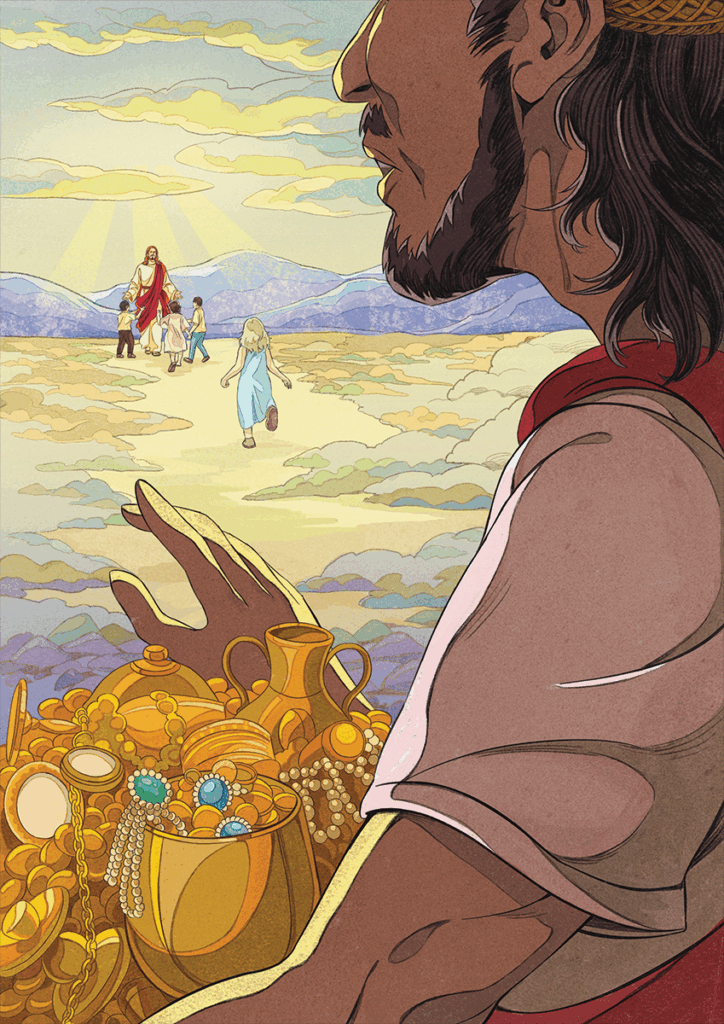
America’s Noah Lyles, the current Olympic champion, won his first 100m world title in 2023. A year later, he scooped Olympic gold in Paris. Noah is still in his 20s. Track running is a young man’s game.
It is because he ran to Jesus that the “Rich Young Ruler” of the Gospels is described as “young” (Mark 10:17); older and wiser guys don’t run.
Gospel writers Matthew, Mark and Luke see his encounter with Jesus as a follow-up to Jesus blessing little children (for example, Mark 10:13-16).
The man — Luke describes him as a “ruler” (Luke 18:18) — addresses Jesus as “good teacher” (v. 17). Maybe the man is being polite or trying to make a good impression. Possibly, though, there is something that he has seen and heard in Jesus’ meeting with the moms and kids (Mark 10:13-16) that makes him realize what kind of person Jesus is.
He asks Jesus: “What must I do to inherit eternal life?” (v. 17). There is no more important question than knowing how to gain life with God in this world and in the next.
His focus is on “eternal life.” Eternal life is not a major doctrine of Old Testament Judaism. David speaks of dwelling “in the house of the Lord for ever” (Psalm 23:6) and Daniel 12:2 refers to a resurrection “to everlasting life.” There are only hints. If the phrase “eternal life” belongs to Jesus, then the man has heard it from Him.
The man asks: “What must I do?” As he knows the Ten Commandments, we assume that he is Jewish and knows the Mosaic Law. The Law has 613 “thou shalts” and “shalt nots.” They cover many aspects of everyday living.
Any man who takes his bar mitzvah (“son of commandment”) undertaking seriously is used to doing things out of religious obligation and observance. This man’s spiritual understanding, therefore, is based on doing religious things.
When it comes to eternal life, the man misses the point. Eternal life is not gained by doing religious things or by completing a moral to-do list. Surrounded by children, Jesus has just said that “anyone who will not receive the kingdom of God like a little child will never enter it” (Mark 10:15 NIV).
Very young children need someone to feed them, wash them, dress them and change their diapers. The man hasn’t understood that if he wants a place in God’s kingdom, he has to stop relying on doing things and instead become totally dependent on the grace of God.
The next part of his question is about inheritance. Maybe the rich young ruler has great wealth (v. 22) because he has inherited from his father. In the Old Testament wealth was passed from fathers to sons. When it comes to eternal life, the man has gotten it wrong again. A place in the kingdom of God cannot be inherited from family. It is the result of a personal relationship with Jesus.
The man’s misunderstandings should come as an encouragement. We don’t have to understand everything before Jesus will talk to us.
Jesus gives the rich man a credit check: “You shall not murder, you shall not commit adultery, you shall not steal, you shall not give false testimony, you shall not defraud, honor your father and mother” (v. 19 NIV).
The man calculates that he’s in the clear. He’s got to be in the kingdom for sure. “Teacher,” he says, “all these I have kept since I was a boy” (v. 20 NIV).
Jesus knows the man has gotten only six out of ten. God is not mentioned in this list. Jesus cuts to the issue that the man values most in his life — money.
He tells the rich and influential ruler that he hasn’t arrived. “One thing you lack,” he says (v. 21 NIV). The Greek word for “lack” means “last place.” In his Gospel, Luke uses it to describe the financial status of a widow who puts all her money into the Temple treasury: poverty (Luke 21:4 NIV).
Effectively, Jesus is telling the financially rich man that he is spiritually bankrupt.
Jesus offers him the solution — the deal of his life, the deal for his life: “Go, sell everything you have and give to the poor, and you will have treasure in heaven” (Mark 10:21 NIV).
This does not mean that he — or we — can buy eternal life. This is not about money. This is about how life is invested. Jesus makes the connection between material worth and spiritual value when He says: “For where your treasure is, there your heart will be also” (Matthew 6:21 NIV).
On one level, Jesus is telling the man to let his money do some good; to change other people’s lives.
On another level, Jesus is challenging the man’s priorities and mindset. He’s saying: “Dump the one thing that gives you status, identity and security.”
The selling of “everything” means the man will lose power over his own life and loss of influence over other people. Can the man whose money has made him the center of his own world give up his independence? Can he become like a little child? It’s a big ask.
Then comes the big call. “Follow me,” invites Jesus (v. 21).
In the ancient world, to follow a teacher is to become their disciple. The Greek word for disciple means a learner. Jesus, therefore, is calling the man of money, status, influence and power to give them all up and become a child-like learner of Jesus. If he wants eternal life, it’s all of him for all of Jesus.
The man has seen Jesus with children and counted himself a shoo-in for the kingdom. He has miscalculated. The man who ran to Jesus can’t stretch to meet the demands of Jesus. Empty-handed and heavy-hearted, he leaves “sad, because he had great wealth” (v. 22 NIV).
Jesus remarks, “How hard it is for the rich to enter the kingdom of God!” (v. 23 NIV). This is not a condemnation of wealth itself but a warning of how the accumulation of wealth can become the sole focus of life. Relying on what money can buy can lead to spiritual bankruptcy.
Whatever our income, eternal life is a gift that cannot be earned. We can receive it when we abandon everything we value and, like children, become dependent on Jesus.
Spiritually Bankrupt: Mark 10:17–27
As Jesus was starting out on his way to Jerusalem, a man came running up to him, knelt down, and asked, “Good Teacher, what must I do to inherit eternal life?”
“Why do you call me good?” Jesus asked. “Only God is truly good. But to answer your question, you know the commandments: ‘You must not murder. You must not commit adultery. You must not steal. You must not testify falsely. You must not cheat anyone. Honor your father and mother.’”
“Teacher,” the man replied, “I’ve obeyed all these commandments since I was young.”
Looking at the man, Jesus felt genuine love for him. “There is still one thing you haven’t done,” he told him. “Go and sell all your possessions and give the money to the poor, and you will have treasure in heaven. Then come, follow me.”
At this the man’s face fell, and he went away sad, for he had many possessions.
Jesus looked around and said to his disciples, “How hard it is for the rich to enter the Kingdom of God!” This amazed them. But Jesus said again, “Dear children, it is very hard to enter the Kingdom of God. In fact, it is easier for a camel to go through the eye of a needle than for a rich person to enter the Kingdom of God!”
The disciples were astounded. “Then who in the world can be saved?” they asked.
Jesus looked at them intently and said, “Humanly speaking, it is impossible. But not with God. Everything is possible with God.”
Illustration by Weston Wei | This article was originally titled “Rich Man Fails Credit Check: Mark 10:17–27” in the September 2026 issue of The War Cry.