Understanding Luke 19:1–10: A Bible Study on Zacchaeus
A powerful encounter with Jesus transforms Zacchaeus from a man focused on taking, to one determined to give, repent and make things right.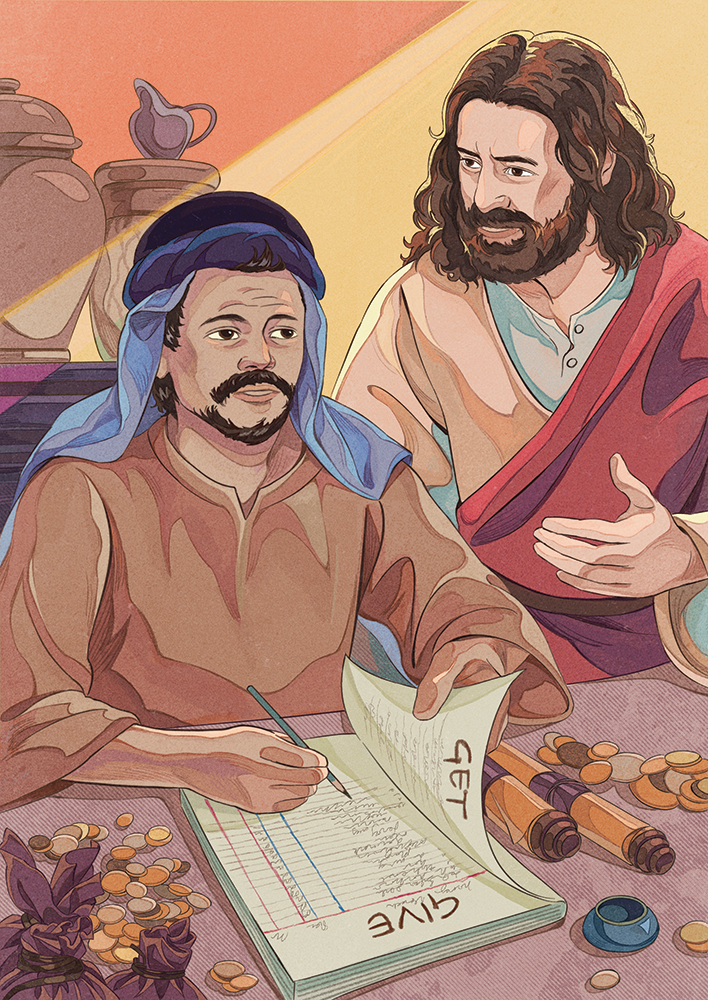
It is said that there are two certainties in life: death and taxes. In reality there is a third: nobody likes paying taxes. In the Gospels, the collection of tax is the setting for the birth of Jesus. Luke connects the reason Jesus was born in Bethlehem with a census ordered by Caesar Augustus. The purpose of such head-counting was not imperial vanity but registration for future taxation.
With a widespread fighting force to maintain, the Romans were enthusiastic tax collectors. Invading Judea in 63 BC, Rome rolled out her tax-gathering machinery, imposing direct taxes on land and people and indirect taxes on goods and their movement. Import tariffs were paid at city gates or at toll centers on strategic routes. Sitting at the crossroads of ancient north/south and east/west trade routes at the southern end of the Jordan Valley just north of the Dead Sea, Jericho was one such toll-harvester.
At 846 feet below sea level, the oasis of Jericho is the world’s lowest-lying population center. According to Roman historian Josephus, tax-attracting balsam “is the most precious drug that is there, and grows there alone in Jericho.” Jericho is also home to King Herod’s winter palace — an in-your-face reminder to the locals of how some of their taxes are spent.
When Jesus passes through Jericho, he meets chief tax collector Zacchaeus. The King James Bible calls Zacchaeus a “publican”; this means more than being an employee of the IRS.
To garner taxes, the Roman engaged “publicani,” local men who bought a licence to gather taxes. An individual “publicanus” could then charge his countrymen what he liked and pocket the difference. Anyone who worked for the forces of occupation was regarded by their fellow citizens as a collaborator — a sucking parasite and social pariah.
As a team-leading “chief,” Zacchaeus has regular contact with the Roman authorities. He is “wealthy” (v 2). While his bank balance may be gigantic, he is not. Zacchaeus is “a short man” (v 3).
Any physical attribute that makes a person noticeably different often leads to ridicule or abuse. They get picked out and picked on. It’s likely that Zacchaeus has had a lifetime of jabs and jibes at his lack of height. Maybe, being an object of ridicule has driven him to success — to prove something to himself and to others — so he focuses on getting rich quick.
Accustomed to compensating for his lack of height, Zacchaeus climbs a tree so that he can get a good view of Jesus from above the crowd (v3 and 4).
Whatever Zacchaeus’ past, right now he wants to see Jesus and, whatever Zacchaeus’ past, Jesus wants to see him. Jesus spots Zacchaeus, calls him down and says he wants to spend some quality time with him away from the crowd (v 5).
This makes Jesus stand out. Because his knock means payment, Zacchaeus is a man that nobody wants to see at their door. Few want to visit him at home, but Jesus does. This is more than a fleeting visit or PR gimmick. The Greek word for “stay” — “meno” — (v 5) means “remain.” The King James Bible renders it as “abide.”
Jesus is en route to Jerusalem (v 28), which is 18 miles and a 3,400-foot climb away. As the parable of the Good Samaritan records, the route through the hills is a good place to hijack a weary traveller (Luke 10:30). Night travel, while cooler, will be more hazardous. Jesus needs a place to overnight in Jericho and of all the people who would willingly host him, he chooses the one least likely: Zacchaeus.
How Zacchaeus’ day has changed! At the start, all he wants is a glimpse; now he has a guest. He shimmies down from the tree and welcomes Jesus “gladly” (v 6). The King James Bible describes Zacchaeus reacting “joyfully.” Given his chosen occupation, such moments of joy are likely rare for Zacchaeus.
Luke uses the word “chairon”. The only other time it appears in the Gospels is when Luke describes the shepherd “joyfully” returning with his lost sheep (Luke 15:5). Jesus sees Zacchaeus as a lost sheep that has gone astray.
Once the enemy of Jericho, Zacchaeus is now the envy of Jericho. Deciding that Zacchaeus is not worthy of the honor of hosting Jesus, they mutter, “He’s gone to be the guest of a sinner” (v 7). This is scandalous. Of all the people in the lowest town on earth, Jesus is going to overnight with the lowest of low life. The townsfolk brand Zacchaeus a “sinner” because they know what he does. Being a sinner, though, is defined by more than what a person does.
The Greek word for sinner is “harmartolos”, meaning “to miss the mark.” There are many ways to miss the mark. We fall short of God’s standards through word, thought and deed; through attitudes, actions, reactions and inactions. Virus-like, sin permeates into every aspect of our being. Paul spotlights this universal shortcoming: “For all have sinned and fall short of the glory of God” (Romans 3:23).
What the grumbling people of Jericho don’t realise is that Zacchaeus is not the only sinner in town. They too are sinners. The difference is that the money man wants to clear his account. He knows he has sinned. He is uncomfortable in his sin and longs to put things right.
Before he fesses up, Zacchaeus stands up. His body language speaks volumes. The act of standing says he means business. He doesn’t want to wait until the end of the tax year or until his books are straight. He has already scaled a tree to see Jesus and he is desperate to do business with him. “Here and now,” he says, “I give half of my possessions to the poor” (v 8).
Zacchaeus’ whole life — right down to every last cent — has been focused on get-get. Now he wants to give, give. Before, he was centered on self. Now he thinks of others. This is repentance. More than feeling sorry for wrongdoing, repentance is a complete 180-degree change of mind and of behaviour. It is more than emotion; it is a decision.
Zacchaeus doesn’t want to do things by half measures. He wants to come completely clean. “If I have cheated anybody out of anything, I will pay back four times the amount,” he says.
The Greek word for “cheated” — “sukophanteo” — suggests how Zacchaeus became rich. Literally meaning “fig-shower,” the Greek historian Plutarch used it to describe those who falsely informed the authorities about illegal fig exporters. Perhaps this is why the King James Bible describes Zacchaeus’s treacherous action as “by false information.”
Collaborator, cheat, swindler, liar, betrayer, Zacchaeus is a real low life. Yet because he admits he’s a sinner, because he repents and offers restitution to those he’s hurt, because he puts his faith in Jesus, he is not so low as to be beyond the reach of divine mercy. “Today,” says Jesus, “Salvation has come to this house” (v 9).
Zacchaeus is not the only one who can be put right with God. Jesus has come to “seek and save what was lost” (v 10). However much we have fallen short, through repentance and faith in Jesus, our slate can be wiped clean.
Jesus and Zacchaeus: Luke 19:1–10
Jesus entered Jericho and made his way through the town. There was a man there named Zacchaeus. He was the chief tax collector in the region, and he had become very rich. He tried to get a look at Jesus, but he was too short to see over the crowd. So he ran ahead and climbed a sycamore-fig tree beside the road, for Jesus was going to pass that way.
When Jesus came by, he looked up at Zacchaeus and called him by name. “Zacchaeus!” he said. “Quick, come down! I must be a guest in your home today.”
Zacchaeus quickly climbed down and took Jesus to his house in great excitement and joy. But the people were displeased. “He has gone to be the guest of a notorious sinner,” they grumbled.
Meanwhile, Zacchaeus stood before the Lord and said, “I will give half my wealth to the poor, Lord, and if I have cheated people on their taxes, I will give them back four times as much!”
Jesus responded, “Salvation has come to this home today, for this man has shown himself to be a true son of Abraham. For the Son of Man came to seek and save those who are lost.”
Illustration by Weston Wei | This article was originally titled “Zacchaeus the Lowlife: Luke 19:1–10” in the November 2026 issue of The War Cry.