


Everything is Redeemable: Jason Gray on Songs, Healing, and Finding Meaning in Music
"'The Wound is Where the Light Gets In' represents a message that I keep returning to in my music, the idea that God is able to work all things together for the good of those who love Him, that everything is redeemable."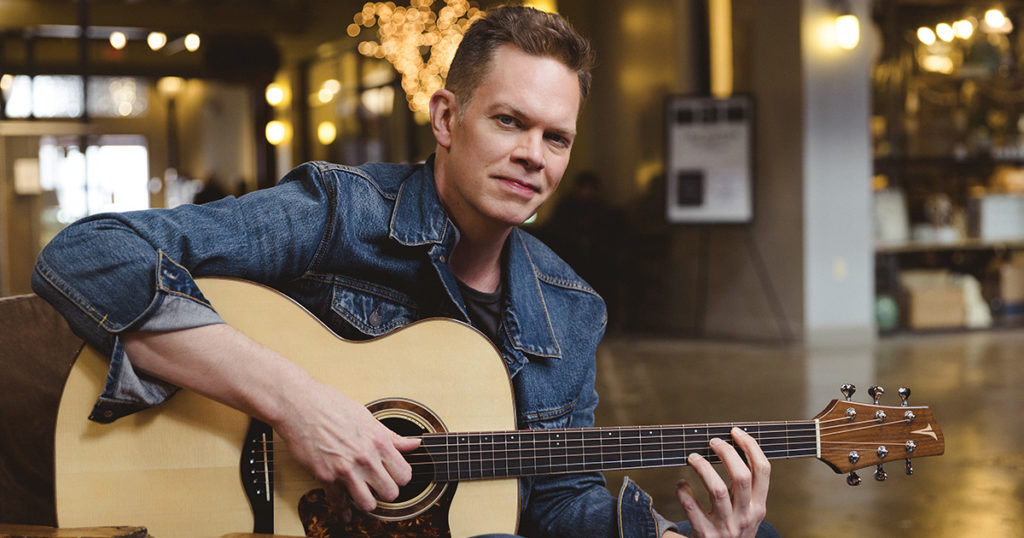
With his latest album “Greatest Hits (Acoustic),” award-winning singer/songwriter and author Jason Gray revisits hits such as “Remind Me Who I Am” and “With Every Act of Love.” In this interview with “The War Cry,” Gray reflects on 19 years in contemporary Christian music and his role as an artist.
The War Cry: Where do you find your artistic inspiration?
Jason Gray: I don’t want to sound pretentious because I think everybody does this. I think we’re all “noticers” to some degree; we’re all tuned to the world a certain way so that we notice things. The people that we call “artists” are the ones who report back on what they notice, either with a song, a poem, or a film they write or an interview that they do. I think the people that we call artists have the best of them anyway, those who understand curiosity as a divine homing signal that God has put in us. They’re just comfortable with it and lean into it.
Jordan Peterson made this observation that if an artist sets out to do a creative work and if they know what it’s going to say at the outset, then it may not be art. It may be propaganda, and propaganda doesn’t have to be a dirty word. But I think as a religious person doing creative works, there is a danger for the creative output to be propagandistic, and like, “I’m gonna use this to preach the gospel”; it becomes a tool that you use rather than an investigation into mystery.
I remember when my son came home from youth group. “How’s youth group, guys?” He goes, “Oh, it’s fine. We just watched a Christian movie.” “Oh, okay. What’d you think of it?” They weren’t all that into it. I was like, “I understand that. Let’s be curious about that, about why a certain kind of movie like that doesn’t captivate us.” And we determined that it was because they already knew where it was going before it got there. I think that’s because it’s probably propagandistic. One of my heroes is Paul Simon. His music is so truthful, and it brings me into deeper insights of the mystery of life and God, the afterlife, and all that kind of stuff. And that’s because he doesn’t have a horse in the game. He’s not creating propagandistically. He’s curious. He’s quiet, and a line comes to him, and he writes it as an opening line. And then he’s like, “Huh, I wonder where that’s trying to take me.”
I’m trying to learn how to be more like that. As a Christian creative person, I think there’s a lot of expectation from people. They want you to say certain things. And then it’s no longer really curiosity, it’s asserting these ideas rather than being open to the mystery of being and seeing if it’s trying to tell me something that I don’t already know. So, I’m trying to be more like Paul Simon. And paying attention to what grabs my attention, what captivates me, and then reporting back on that.
WC: Is music as powerful of an evangelism tool now as it was when you first started 20 years ago?
Jason: It depends on what kind of evangelism you want to do. When I started out, there were a lot of opportunities to play in churches because Christian music was still in its infancy, and it was still aimed at youth culture. The church valued it because it brought in the youth, and it was an evangelism tool. Today churches aren’t as excited or open or as inclined to bring in a musician as they used to be. At the same time, the demographic for Christian music has gotten older as well. I don’t know if the church sees it as effective of an outreach tool as it used to. Maybe that’s okay because to reduce music to only an outreach tool is maybe to miss the deeper thing that it would like to offer us. My personal experience is that music is one of the ways that God speaks to me, but it has a restorative effect, and it can realign me with truth.
I think of the churches that can recognize and honor music for what it is. My sense was that the usefulness of music is setting the stage on a Sunday morning for the pastor to bring a message. That’s a fine use for music, but when you begin to recognize that music is meant for so much more, we’re underutilizing it by being too pragmatic with it. I’m always grateful when I’m in a church that seems to have a sense that music has a value and is doing an important work in and of itself apart from if it’s useful as an outreach or setting the stage emotionally. It’s more than a tool. There’s something mysterious and sacred happening in music.
WC: How has the Christian music scene changed in the last 20 years?
Jason: There are people who come in, co-opt it and franchise it. Worship music is becoming the dominant part of contemporary Christian music right now. I’m in writing rooms that have cracked the code on how to write a worship song that works. The danger in that is that in some ways, I see it as the knowledge of good and evil. I don’t want to know what works because the moment I know what works, I’m tempted to lean on my own understanding and am in danger of being manipulative.
Underneath everything, sometimes I’m concerned about those trends. When I look back on those old worship choruses of the 80s and the 90s, some of them were maybe a little hokey, but man, they were so authentic. They were so sincere, and this hadn’t become an industry yet where they could benefit as much. It was a genuine overflow of the heart.
WC: Would you advise newer artists to think outside the box?
Jason: Yeah. Develop authenticity and complicate your theology by reading works by people that you don’t agree with, be humble in what you want to sing about, and be in love with Jesus. I think you can either love what you know or you can love what you don’t know. If I’m actively loving what I know, then I’m just stating the things I already know. If I’m actively trying to love what I don’t know, that’s curiosity and openness. I hope we can do a lot more of that. I think that’ll produce less commercial but more interesting, more truthful art. Like Paul Simon.
WC: What excites you about being a Christian musician in 2026?
Jason: I love performing live. I love connecting with people. The thing that I enjoy the most during that hour and a half that I’m on stage is when I’m the most in tune with the Holy Spirit. I’ve come to recognize the voice of the Spirit better there than anywhere else in my life. Selfishly, I like that piece of it. I like that music has meant a lot to me. It’s helped me. God has spoken to me through music, through that language.
I was going through a catastrophe in my life about 10 years ago, a divorce that I didn’t want and I didn’t see coming. It was just devastating and broke me a hundred different ways. In the midst of that, I met a mentor. He walked with me through that. I remember having a moment with him where I said, “George, I want to thank you for helping me heal.” He said, “Oh, I can’t help you heal. That’s above my pay grade. What I can do is help you heal your language. If your language gets healed, then between you and the Holy Spirit, you’ll heal on your own.” A lot of his work with me for eight years was just tweaking my language.
What excites me the most is paying attention to when the Holy Spirit is drawing my attention to a phrase or some healed language. I’m like, “Oh, how can I make that into a song that I could put out there and that might be helpful for others, too?”
WC: Which of your own songs is your favorite?
Jason: My first favorite is whichever one you like the most, because it means so much to me that you give a song of mine a home in your heart. Whenever I play a song live and hear the audience loves it, that’s so meaningful to me. That’s normally “Remind Me Who I Am” or “Sparrows.” I’m also very happy with how both of those songs turned out on my Acoustic Greatest Hits album.
The song that I’m proudest of is probably “The Wound is Where the Light Gets In.” Rich Mullins said that a preacher basically only has three or four sermons that he preaches over and over again. “The Wound is Where the Light Gets In” represents a message that I keep returning to in my music, the idea that God is able to work all things together for the good of those who love Him, that everything is redeemable. I did it best with that song. A mentor of mine said, “I don’t trust anybody who hasn’t been broken.” I think about that a lot, and that song reflects that.
The other thing I am proud of in that song is that it’s very image driven. As a songwriter, what I love about Paul Simon is rather than saying the thing, he says the thing that makes you feel the thing. In the 80s, Michael Bolton sang, “Love is a Wonderful Thing,” that was a big song for him that resonated with a lot of people. There isn’t anything wrong with that. That’s great. He said the thing. It’s very on the nose. Then, you have Paul Simon, and he sings, “Love, we need it so badly. It makes you want to laugh out loud when you receive it and gobble it like candy.” That makes you feel that love is a wonderful thing.
“The Wound is Where the Light Gets In” is where I really leaned into that. “I’ve stood there like a hostage with a knife held to my vein, captive to the poison that I took to numb the pain. Because everybody wishes they were born with thicker skin, but the wound is where the light gets in.” Dan Hasseltine of Jars of Clay wrote that with me. That kind of image-driven lyric is not always rewarded in the Christian music marketplace. It was never going to be a radio single, but I’m very proud of the lyric.

WC: What was it like re-visiting and re-recording those songs, especially with your son Kipper producing the album?
Jason: So fun. He’s brilliant. One of the gifts of doing that with him was getting to experience a dimension of him that I wouldn’t normally get to. He’s really great at his job, and he’s great at handling the artists he’s working with, making them feel secure. He appreciates their work. He’s very impressive in those ways. I don’t know that I would have seen that if we hadn’t worked with each other. That was a blast, and he’s just hilarious too. It’s a great hang.
The first time I recorded those songs on their respective albums, I had a blast. I’ve been very blessed to work with great people, and I’m very happy with the way those songs originally turned out. When I was recording them, there was a little bit of anxiety always in the mix of, “Is this going to work? Are we recording it in a way where it’ll realize its potential?” Re-recording it, all that anxiety was gone because the song had already worked. It turned the songs into a playground, where I just got to enjoy them as songs and just follow our delight, our curiosity. “Remind Me Who I Am” has primarily a banjo as the main instrument on the re-record. I usually associate the banjo with bluegrass. We didn’t do that approach at all, so it has a vibe to it. It’s haunting, and it’s cool. We went that way because it was cool, and we were delighted by it, so we followed that. Whereas if I had been recording it for the first time, I would not have gone that direction because I’d think, “Banjo, I don’t know if that’s going to work.” I got to be delighted and lean into that on these new versions.
WC: What’s next for you?
Jason: I’ve been working for four years on a book of devotional essays for all the songs I’ve ever released, and I’m in the very last lap. It’s going to the printers imminently. In the midst of that, I’m also writing songs for my next record.
After my divorce, I went through a period of disillusionment. In the midst of all of that, all of the hurt I’d accumulated from the church over the years caught up with me, and I was just done with church, religious people. When I would see stories in the news about the church or religious people, that would be my attitude. I kind of rolled my eyes, and I realized, that’s contempt. That meant I’d allowed my hurts to harden into resentment. Whatever justification I may have had for those hurts, resentment has no business in the heart of the pursuer of Jesus. I had to clean that up. I thought one of the ways that I might do that was by writing a group of songs that reminded me about what is beautiful about the church, and it worked. It healed a lot of that and cleared out a lot of the resentment. I have a home church again. I’m having a blast writing an album about the church. Each of the songs will be an exploration about what’s really happening underneath the surface when we worship, when we listen to the preacher, or when we tithe. It’s been very meaningful to work on that and to investigate and plumb the depths of that experience we all enjoy on Sunday mornings.
Gray’s newest album, “Greatest Hits (Acoustic),” is available from Centricity Music and on all major streaming platforms.
Photograph by Crystal Martel