


They Came Hungry. They Found Jesus.
“I’ve heard more theological depth come out of a person who is in addiction, sitting around those tables, than I have anywhere else.”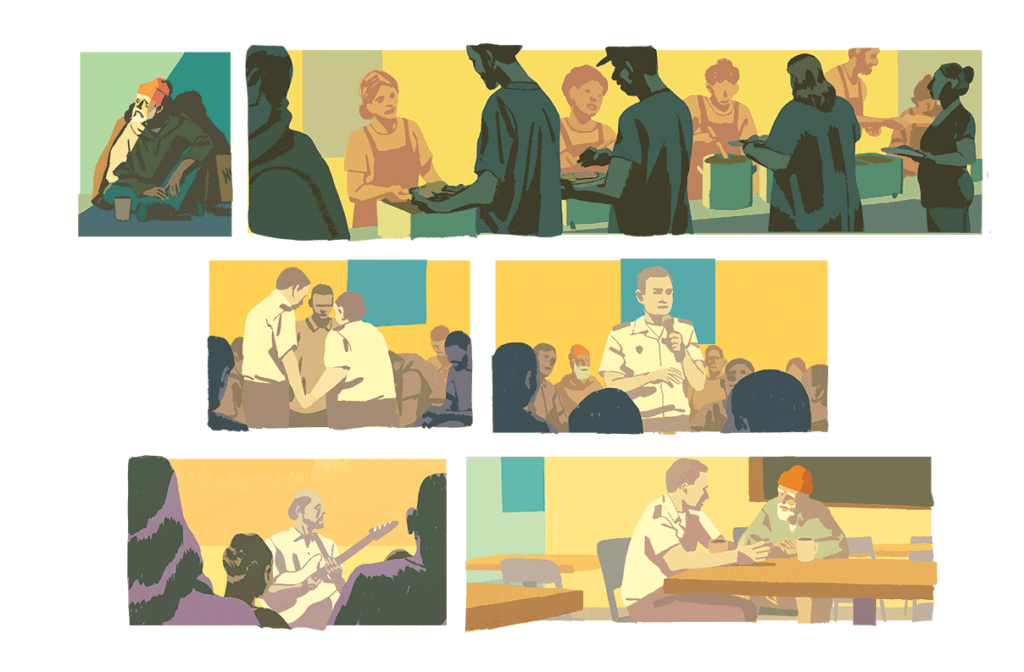
For a little more than a year, Lieutenant (Lt.) Donald Cooper and his team of volunteers have been hosting a community dinner and church service (referred to simply as “dinner church”) that’s been growing at an incredible rate and getting some attention after being featured at the Central Territory’s Congress last June. Their weekly worship service caters specifically to people wandering in off the street, often just looking for a hot meal. Lt. Cooper has a heart for ministering to this demographic because he’s been there himself. “I was the worst of the worst,” said Lt. Cooper. “[People] said, ‘He’s done. He’s never going to make it out.’ I was the guy on the street corner. I was a thief, robber, all that stuff.” He grew up in a church and even felt the call to ministry at a young age but fell into addiction when he was prescribed opiates after his service in the US Army. From there, he moved on to heroin, meth, and a life on the street.
Lt. Cooper described what it’s like to be ignored in your church home, when that’s where you need to be while trapped in sin the most. “I went through this phase of God being so distant, and I felt so unwelcome by church people. I felt so judged by the people I grew up with, in the church that was supposed to love me. I knew that my healing was in Jesus. I just wasn’t allowed in those spaces where I thought Jesus was. You get put in the back row, and a babysitter gets put with you so you’re not looking through drawers or whatever. It’s always like, ‘Come to church,’ but when you actually show up, you’re not welcome there.” After several stints in jail, Lt. Cooper finally recovered thanks to The Salvation Army’s Adult Rehabilitation Center. Given his life experience, he felt well-suited to plant the Prospect Corps after being appointed there upon his commissioning as a Salvation Army officer in 2024.
Lt. Cooper wasn’t sure what the corps would look like or how to get started, so he steeped himself in prayer. He also spent a lot of those first few weeks walking around and getting to know the community, and he very quickly realized that a traditional Sunday morning service wouldn’t work for the people in that neighborhood. “There was a lot of church hurt in the community. A lot of people wanted to be in church, but they wouldn’t go because they weren’t welcome.” When the idea for dinner church came to him, he ran with it. Lt. Cooper credits the Dinner Church Collective, a group of churches across the nation, with inspiration for his approach. He printed out flyers advertising a “Community Meal” in large text, followed by “Jesus Message” in a much smaller font, hoping not to scare anyone away. That first Sunday, a crowd of homeless people and people being trafficked came for the meal but were hooked by Lt. Cooper’s message when they realized he’d been where they were. Over a year later, Lt. Cooper says those people who came that first Sunday still come every week.
When I visited the Prospect Corps, I showed up two and a half hours before dinner church was set to start, and already a handful of dedicated volunteers from other corps around the area were bustling around and setting everything up as worship music echoed throughout the building. After touring the facility and talking to the volunteers, I thought I knew what to expect from the evening service. But when the Prospect Corps’ tiny chapel was packed to the gills, with a not insignificant amount of overflow listening in from the dining room just outside, I was reminded of how often the Holy Spirit defies our expectations. I stood in the back of the chapel watching and listening as people with nowhere else to go worshipped with abandon and poured their hearts out to their fellow believers. In that time, it felt as though my redeye flight and six hours of delays never happened.
The service was peppered with opportunities for the congregation to share their testimonies and prayer requests. One woman took the microphone to declare that she was ready to go to treatment for her addiction. “She’s never said that [before],” Lt. Cooper said, noting that this was a significant moment for the woman. “Every week she takes the microphone and begs Jesus to deliver her from drug addiction … Every week you hear people crying out to Jesus to deliver them.” I could’ve stood there listening to these testimonies and Lt. Cooper’s Scripture recitations for hours. But it only lasted for about 50 minutes. The room emptied, everyone eager for the “dinner” part of dinner church. On my way to the meal, I looked down at a little shelf by the door, where an offering plate had been sitting during the service, empty and unaddressed by Lt. Cooper or the volunteers, now completely full. I was awestruck, wondering how people who have very little could be so generous.
“The people that we serve are sort of on the outside of the church and have been for years,” said Lt. Cooper. “They come in, and you see them feel the Holy Spirit for the first time again in worship. And their eyes are just open, or they begin crying like, ‘Oh yeah, I remember that Man. I remember that Spirit. I remember this feeling of the physical presence of Jesus from growing up.’ And ‘Oh yeah, He’s here again. He wasn’t ever gone. I was gone, but He’s here right now with me.’ The lure is food. The lure is hygiene. The catch is a relationship with Jesus.”The crowd flowed out from the chapel and into the dining hall, and shortly after that, they were served a meal of spaghetti (which Lt. Cooper had been cooking all day) and fried chicken. As everyone ate, Lt. Cooper weaved through the room with his microphone, delivering a sermon on a passage he’d read earlier. He engaged with his congregation physically and had them answer questions on slips of paper so they could engage right back and discuss Scripture with their neighbors. For this crowd, the likes of which you wouldn’t see at a regular Sunday morning service, it seemed the perfect way to share the good news. “I’ve heard more theological depth come out of a person who is in addiction, sitting around those tables, than I have anywhere else,” Lt. Cooper said. He later told me that soldiers from other corps are at each table in plainclothes every week, guiding conversations and loving on the congregation. I had never experienced anything quite like Prospect’s dinner church — and yet it still felt familiar, comfortable, like home.
“If we’re trying to do the original mission of The Salvation Army, seeking the lost, the hurt, those people are not going to come to Sunday morning church,” said Lt. Cooper. “Now people are experiencing six- or seven-day work weeks. If they have a day off, it’s on Sunday morning. They want to rest. They want to spend time with their families. It would be coming from a privileged place for us to say, ‘No, your one morning off, you need to come to church.’” Lt. Cooper is adamant that “church” can be whenever, so long as people show up. The service can be adapted to suit the community. “We can move church to Sunday night or Monday night, or Tuesday night to reach people. Our growth is because it’s not on Sunday morning … If we want to grow, we have to look at moving church.”With the energy and sense of revival at Prospect Corps, it’s easy to see Lt. Cooper’s point — church doesn’t have to be Sunday morning to be legitimate. The idea’s catching on, too. Lt. Cooper cites a corps in Olathe that now has a monthly “market church,” where the gospel is shared in a farmer’s market setting rather than a traditional meeting. Adapting a church service to fit a community’s needs has often proven to be a great way to draw new people to the faith. When the meal ended, the congregation lined up to collect a handful of free hygiene products before they left for the night. And with that, the night was over. Everyone left, and I also headed off for the evening to consider the beautiful service.
My evening at the Prospect Corps left no doubt in my mind as to why dinner church is working and attracting over 150 people every week: the focus on worship, Scripture and community is a powerful combination that anyone would find inviting. Throw in shared meals, and you’ve got a winning formula. I couldn’t (and still can’t) shake the feeling that Lt. Cooper has tapped into something powerful by identifying his community’s needs and shaping Prospect Corps around it. It’s what made The Salvation Army movement catch on to begin with: giving people what they need, where they’re at.
Right now, Lt. Cooper doesn’t have any plans for the future of Prospect Corps’ dinner church services. He calls himself a “day-to-day” kind of guy and has been completely reliant on the Holy Spirit since the beginning — so much so that he refuses to take any credit for the corps’ growth; he’s adamant that none of it would have been possible without God’s intervention. “The deliverance, the spirit of the community, that’s all Jesus. If it was me at all, it would have failed. It would not have gotten off the ground.” Lt. Cooper plans to continue following the Holy Spirit’s guidance. “If we build anything, if we try to mold or fix this corps to be our idea of a ‘Salvation Army,’ it will fall, it will break, it will crumble. So, myself and anyone coming after me, if we don’t rely on the Holy Spirit to do the growing and the developing, it’s going to end up dead. In my experience, people’s hearts have to be ready to experience Jesus,” Lt. Cooper said. “How do we do that? We create a space that’s loving, compassionate, and hospitable. Our hands are out, welcoming them to the feet of Jesus. The food’s great. The hospitality is really great. The atmosphere, the music is really great — All that, for people to be open to receiving a relationship with Jesus.” When it comes to dinner church, the proof is in the pudding. Lt. Cooper has cultivated an atmosphere where the Holy Spirit is alive and well, and people are encountering Him like never before. I was only there for one evening and experienced that truth. And both Lt. Cooper’s own testimony and the ministry of the Prospect Corps show that God can meet anyone anywhere, so long as they’re willing. Or, as Lt. Cooper puts it, “Jesus can show up in the trap houses.”
Illustration by Patrick Leger